Genshin Impact vs. Honkai: Star Rail - My Epic Tale of HoYoverse's Twin Titans
HoYoverse's flagship titles, Genshin Impact and Honkai: Star Rail, are locked in a spectacular internal rivalry for revenue and player attention.
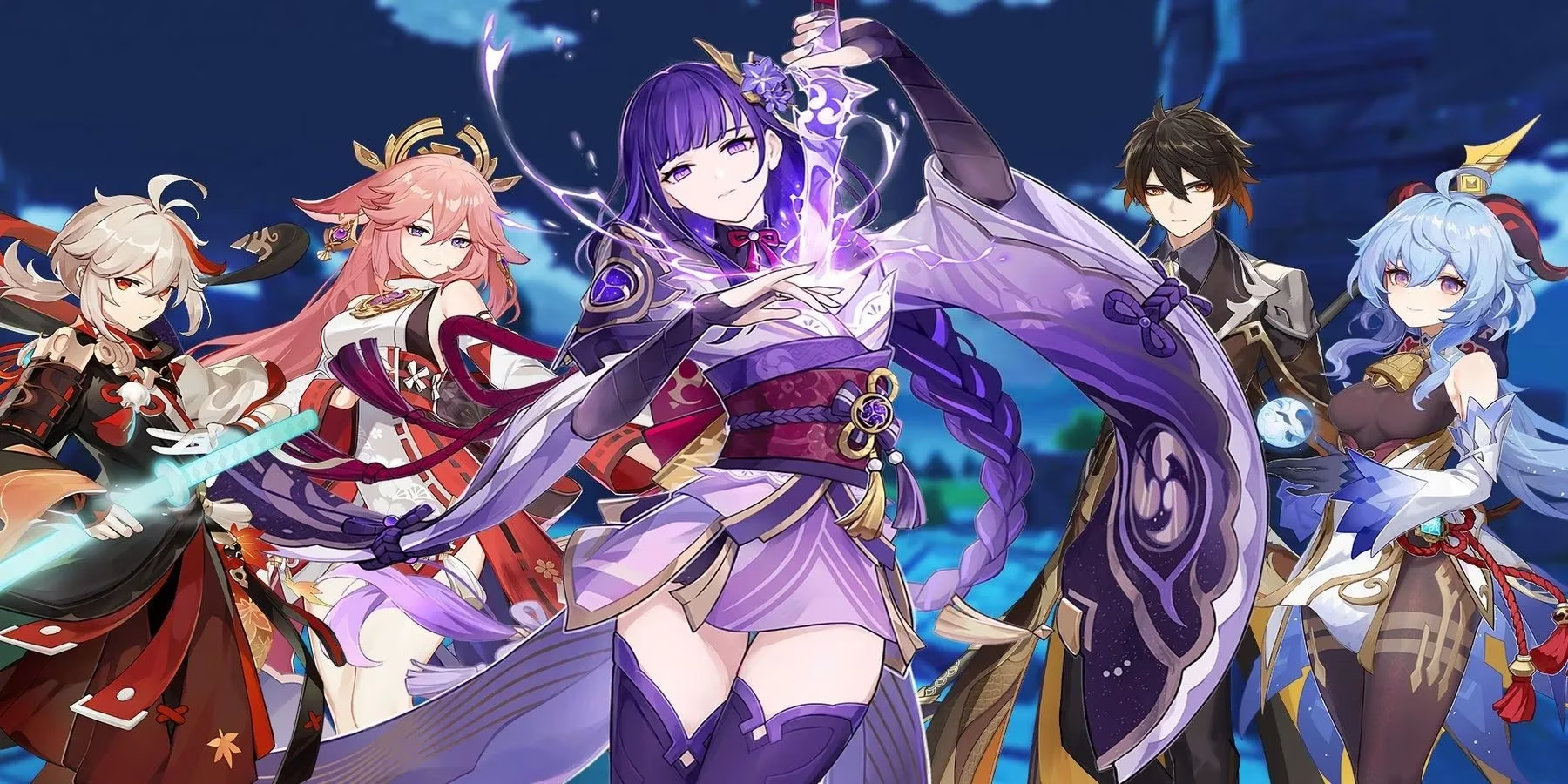
Let me tell you, as a gamer who has ridden the wild waves of Teyvat and soared through the cosmos on the Astral Express, the current state of HoYoverse in 2026 is nothing short of a glorious, self-inflicted civil war! Every developer dreams of having one flagship title that defines them, but HoYoverse? They went ahead and built two skyscrapers on the same street, each trying to outshine the other with neon lights and fireworks. Since Genshin Impact exploded onto the scene back in 2020, it wasn't just a game; it became a cultural landmark, a sprawling, breathing world of Teyvat that we all call a second home. Its identity is woven from breathtaking landscapes, characters with more depth than the Chasm, and combat smoother than a Snezhnayan diplomat's lies. But then, Honkai: Star Rail arrived like a meticulously calculated meteor strike, proving HoYoverse isn't a one-hit wonder but a factory of blockbusters. And now, watching these two titans from the same family duke it out for revenue and attention is my favorite spectator sport.
The Revenue Rollercoaster: A Duel of Digital Dynasties
People look at revenue charts like they're ancient prophecies. When Star Rail pulled ahead a couple of years back, especially with that Acheron banner in March 2024 that raked in a staggering $145 million, the doom-sayers came out in force. They whispered that Genshin's reign was over, that the flagship was sinking. What a hilarious overreaction! To me, this rivalry is less like a death match and more like watching two master chefs in the same kitchen—one specializing in an ever-expanding, earth-bound fantasy banquet (Genshin), and the other serving up a sleek, cosmic tasting menu (Star Rail). Their financial battle is a predictable pendulum swing. Genshin had a lull? Of course! The entire player base was holding its breath and its Primogems for Arlecchino's debut in the 4.6 update. Our wallets are loyal, but they are not infinite. The revenue flow between these games is like a perfectly balanced ecosystem; when one blooms, the other conserves energy, only to burst forth even more vibrantly in the next season.
Foundations of Granite: Why Genshin's Kingdom is Unshakable
Let's get one thing straight: for Genshin Impact to truly be in peril, you'd need to see a mass exodus from Teyvat. And that simply isn't happening. The secret sauce isn't just the world; it's the schedule. HoYoverse has us on a six-week update cycle that's more reliable than a Geo construct. Just as you start to feel the faintest hint of content drought, boom, a new patch drops with a new region to explore, a new story to unravel, or a new character to simp for. This isn't just support; it's a relentless, entertaining siege on our free time.
Furthermore, the player bases aren't mutually exclusive. We are a vast, overlapping Venn diagram of gamers. I, and millions like me, log off from solving mysteries on the Xianzhou Luofu and immediately log in to go treasure hunting in the newly expanded regions of Natlan. Star Rail' planet-hopping sci-fi epic and Genshin's rooted, elemental fantasy are different experiences entirely—like comparing a meticulously engineered starship to a living, growing world tree. One offers the thrill of the cosmic unknown, the other the comfort of a fantasy home that keeps adding new wings and secret gardens. There's room in our hearts and on our devices for both.
The HoYoverse Halo Effect: Rising Tides Lift All Gachas
Some feared Star Rail's success would cannibalize Genshin. Instead, it did the opposite. It created a HoYoverse Halo Effect. Winning awards like Best Mobile Game at The Game Awards 2023 didn't just put Star Rail on the map; it reaffirmed HoYoverse as an industry titan. This reputation draws new players into the ecosystem. Many start with the turn-based strategic depths of Star Rail, get hooked on the quality, and then curiosity pulls them into the vast open-world action of Genshin. We're not choosing one over the other; we're being baptized into the church of consistent quality and relentless content. Each game's success is a billboard for the other, proving this developer isn't about lightning in a bottle, but about building bottle factories that constantly produce lightning.
Gazing into the Crystal Ball (The 2026 Edition)
So, where are we now in 2026? The landscape has only solidified. Genshin Impact has continued its march, introducing regions that have reshaped the very geography of Teyvat. The lore has deepened like the Mariana Trench, with secrets that have us theorists drawing conspiracy boards that look like a Rube Goldberg machine designed by a mad archon. Meanwhile, Honkai: Star Rail has carved out its own legendary status, with story arcs that hit with the emotional force of a supernova.
The revenue charts still dance, but the panic is gone. We understand the rhythm now. A groundbreaking new character in one game will cause a spike, while the other prepares its own counter-offensive. It's a symbiotic rivalry, a perpetual motion machine of content and investment. Genshin Impact's position isn't just secure; it's monumental. It's the foundational bedrock upon which HoYoverse's empire is built, while Star Rail is its dazzling, orbiting satellite. One is an enduring continent, the other a brilliant comet—and we, the players, are blessed to explore both. The idea of one "killing" the other is as absurd as expecting the Anemo Archon to settle down and file taxes. This isn't a battle for survival; it's a masterclass in how to sustain dual legacies. The future isn't a worry; it's a promise of more worlds to get lost in, all bearing the unmistakable stamp of HoYoverse quality. Game on! 🎮✨